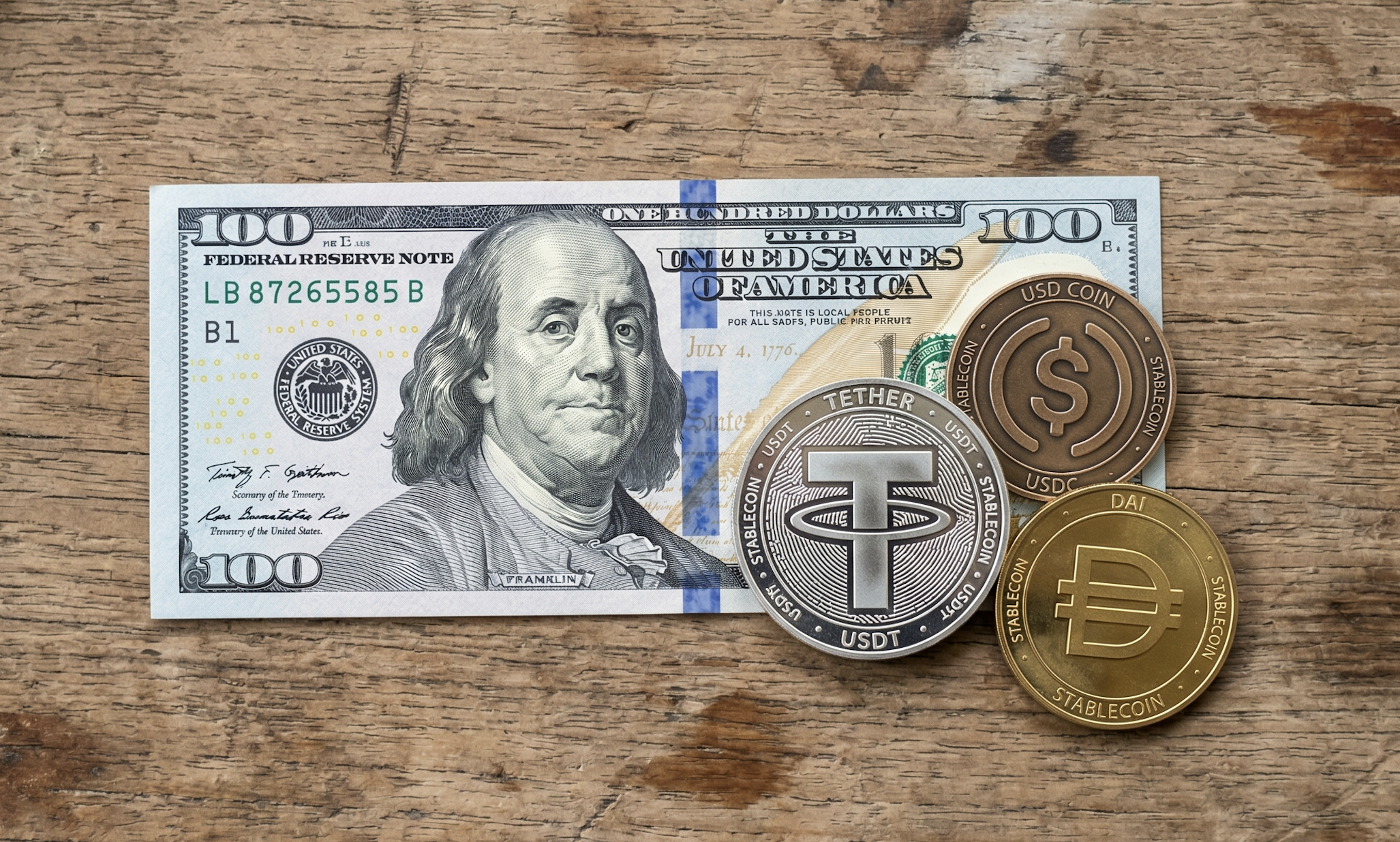
A new narrative has taken hold in the halls of power: the idea that digital “wrappers” around U.S. government debt will preserve American hegemony. Recently, Goldman Sachs’ David Solomon and former Treasury Secretary Steve Mnuchin effectively took a victory lap on stablecoins. Their pitch is seductive: stablecoins strengthen the dollar, create organic demand for Treasuries, and allow those in emerging markets—from Argentina to Nigeria—to hold dollars with ease.
However, beneath this “innovation” lies a more desperate reality. Washington is essentially grooming a $315 billion shadow money market to act as a captive buyer for a debt load that traditional foreign creditors no longer want.
The New Creditors of Last Resort
The United States is currently facing a fiscal storm. With the national debt crossing $39 trillion and interest payments exceeding $1 trillion annually, the government must finance a $1.9 trillion deficit this year. Meanwhile, the “big three” foreign buyers—China, Japan, and Canada—have been pulling back for over a decade. ARK Invest notes that the share of Treasuries held by major foreign creditors has plummeted from 23% to just over 6% in the last 13 years.
Enter the stablecoin issuers. Treasury Secretary Scott Bessent has argued that a “thriving stablecoin ecosystem” will drive private sector demand for Treasuries and help manage the national debt. In essence, when a retail user in a developing nation buys Tether (USDT), they are buying U.S. Treasuries by proxy.
Leading Stablecoins (April 2026)
While the market is dominated by a few giants, the landscape has bifurcated between highly regulated “payment stablecoins” and offshore titans:
- Tether (USDT): The “800-pound gorilla” with roughly $185 billion in circulation and 550 million users.
- USD Coin (USDC): The primary compliant competitor, favored by institutional players and integrated into major payment networks.
- Ethena (USDe): A synthetic “delta-neutral” stablecoin that generates yield through derivatives rather than Treasury backing.
- PayPal USD (PYUSD): A retail-focused entrant leveraging its massive existing merchant network.
- W1USDT: Issued on the Etherstable blockchain, facilitating enterprise settlements.
- Gemini Dollar (GUSD): Issued by the Gemini exchange.
The “GENIUS” Trade-Off
The GENIUS Act, passed in July 2025, provided the first federal framework for these assets, but it came with a heavy cost. Under the Act, stablecoin issuers are strictly prohibited from making loans; they can only hold Treasuries, reverse repos, and cash equivalents. Furthermore, the Act explicitly forbids issuers from passing interest along to holders.
This creates a highly profitable “carry trade” for issuers like Tether—which banked $10 billion in profit last year—while simultaneously starving the real economy. The Federal Reserve has found that for every $1 that moves from traditional bank deposits into stablecoins, bank lending contracts by roughly 50 cents. By the U.S. Treasury’s own estimates, stablecoins could eventually drain $6.6 trillion from the banking system.
The result? Capital that once funded mortgages and small business loans on Main Street is being redirected into government IOUs.
Systemic Risks: Easy In, Ugly Out
Despite the celebratory tone on Wall Street, the stability of this system is fragile. Stablecoin issuers lack access to the Federal Reserve’s discount window. If a “run” occurs, these issuers would be forced to dump Treasuries into the market simultaneously to meet redemptions.
According to Fed Governor Michael Barr, this creates a dangerous “asymmetric” volatility:
- Inflows: Push Treasury yields down by roughly 2–2.5 basis points.
- Outflows: Spike yields upward by 6–8 basis points.
This “run dynamic” could destabilize the very Treasury market these products are intended to support.
The Transparency Problem
Finally, there is the issue of the “800-pound gorilla” itself. Tether, headquartered in El Salvador, operated for 12 years with nothing but quarterly attestations and a history of fighting transparency in court. It only hired a Big Four auditor (KPMG) last week—its first full audit in over a decade.
Wall Street is currently selling this as progress. But the reality is that the U.S. government is increasingly reliant on a crypto-wrapper—run by offshore entities—to finance its trillion-dollar deficits. If the goal is to save the dollar, redirecting the lifeblood of the economy into government debt while concentrating risk in a shadow money market may prove to be a historic miscalculation.